
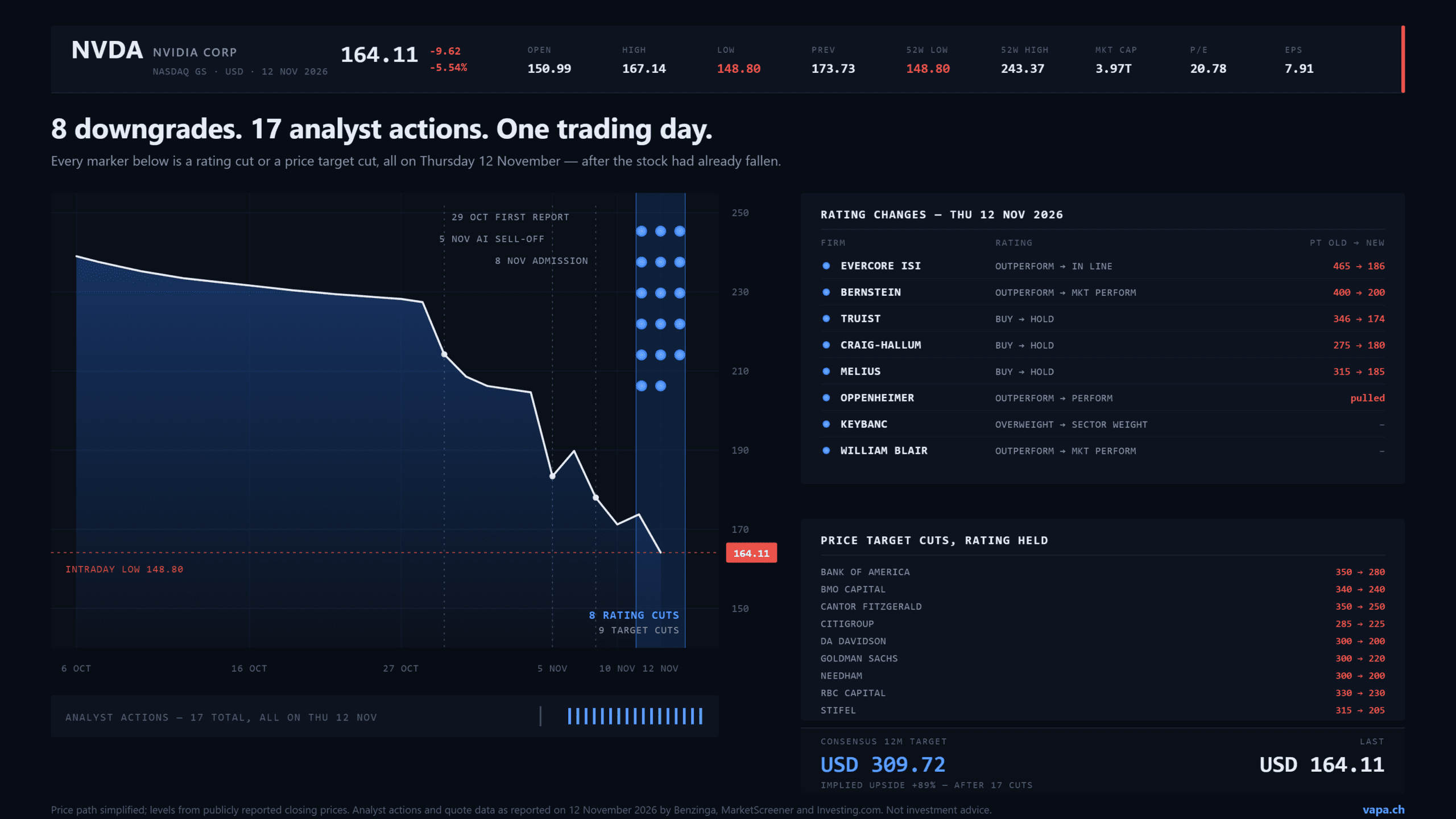
Eight NVIDIA analyst downgrades. Nine further price target cuts. All of them on Thursday, 12 November — one trading session — and all after NVIDIA had already lost 31 per cent from its record high.
The numbers
- 6 October: record high at USD 239.
- 12 November: USD 164.11, down 5.5 per cent on the day, intraday low of 148.80 — a new 52-week low.
- Drawdown from the high: 31 per cent, roughly USD 1.3 trillion of market value.
- Thursday, 12 November: 8 rating downgrades and 9 price target cuts. Seventeen actions in a single trading session.
- Biggest single cut: Evercore ISI, from 465 to 186 — minus 60 per cent.
- Consensus 12-month target today: USD 309.72. That is 89 per cent above the share price.
| Firm | Rating | Price target (USD) |
|---|---|---|
| Evercore ISI | Outperform → In Line | 465 → 186 |
| Bernstein | Outperform → Market Perform | 400 → 200 |
| Truist | Buy → Hold | 346 → 174 |
| Craig-Hallum | Buy → Hold | 275 → 180 |
| Melius | Buy → Hold | 315 → 185 |
| Oppenheimer | Outperform → Perform | target withdrawn |
| KeyBanc | Overweight → Sector Weight | — |
| William Blair | Outperform → Market Perform | — |
The downgrades were only half the story. Nine further firms kept their ratings that day but cut their targets anyway:
| Firm | Price target (USD) |
|---|---|
| Baird | 500 → 200 |
| Stifel | 315 → 205 |
| Citi | 285 → 225 |
| Wells Fargo | 315 → 300 |
| Bank of America | → 280 |
| BMO Capital Markets | → 240 |
| DA Davidson | → 200 |
| Needham | reduced |
| Cantor Fitzgerald | reduced |
Not everyone reached for the knife. Goldman Sachs reaffirmed its Buy rating and USD 300 target into the selloff — even on the worst day, the Street did not speak with one voice.
What actually changed in those few hours
Not the business. NVIDIA last reported revenue up 106 per cent year on year to USD 96.2 billion, and the stock trades at 20.8 times trailing earnings against a five-year median above 50. Guidance of USD 108 billion is due on 17 November.
What changed is that Jensen Huang resigned, and CFO Colette Kress took over on an interim basis. In other words: the cash flows did not move by 60 per cent in a day and a half. The assessment did.
The uncomfortable part is not that the targets came down. It is that Baird’s target of 500 was still standing on Wednesday two weeks after the first newspaper report, and roughly 27 per cent below the high when it was cut.
In fairness to the analysts
- A rating is not a trading signal. It describes expected relative performance over twelve months, not what to do before lunch.
- Governance risk barely fits in a model. No DCF has a line for “founder resigns in six days”.
- The process is slow by design. Supervisory analyst, compliance, sign-off. A firm that downgrades on an unconfirmed report and gets it wrong has a regulatory problem, not just a bad week.
Bernstein said it plainly: the downgrade did not reflect any deterioration in fundamentals. That is honest. The company and the share price are two different things.
Why independent wealth managers are probably at an advantage
The edge is not intelligence. It is the length of the path between seeing something and acting on it. Five reasons, and they are structural rather than flattering:
- The mandate already exists. Under a discretionary mandate, the decision and the order happen the same morning. No calling round, no committee, no publication cycle.
- No published number to defend. A sell-side analyst has to reconcile every move with a target he printed. A wealth manager carries no public position he has to be consistent with.
- No conflict with the issuer. Banks maintain capital markets relationships with the companies they cover. An independent firm sells no research, runs no bookbuilds and has no product shelf to protect.
- No benchmark obligation. NVIDIA was about 5 per cent of the MSCI World in early October. Index- and benchmark-aware investors held that position whether they liked it or not. A single-name cap is a decision an independent manager can simply take.
- Size is an asset here. Trimming a position in one of the most liquid stocks on earth takes minutes for a few hundred million, and days for a large fund.
The honest counterweight: a small firm has fewer analysts, its own key-person risk, and every incentive to mistake speed for skill.
What speed is not
Anyone who sold into the panic on 12 November may have sold at 148.80 — around 10 per cent below where the stock traded a few hours later. Reaction speed without a framework is nervousness with access to the order button.
The work happens earlier: a cap on any single position, key-person risk treated as its own risk category, and a written rule about which kind of news triggers a review. With that in place, you can be fast without being frantic.
The number that stays
USD 309.72 against USD 164.11. After seventeen cuts, the consensus still implies 89 per cent upside. Either sell-side research is still far too high, or the market is wrong. Both cannot be true.
That is the fair verdict on analyst research. It is a serious input and a poor decision-maker. The question worth asking is not what a rating is worth, but who decides in your portfolio — and how long that decision takes to arrive.
Sources: CNBC on the analyst reaction, TipRanks on the wave of downgrades, Finbold on the price target cuts. Quote data as reported on 12 November 2026.
Disclaimer: This post reflects the personal views of the author and is published for information purposes only. It is not investment advice, an investment recommendation, or an offer or invitation to buy or sell any financial instrument. Figures are as publicly reported on 12 November 2026 and may since have changed. Past performance is not indicative of future results. The allegations referred to in connection with NVIDIA have not been conclusively determined. More on our approach: independent wealth managers and tailored wealth services.
Source: https://vapa.ch/nvidia-analyst-downgrades/ · vapa.ch

