
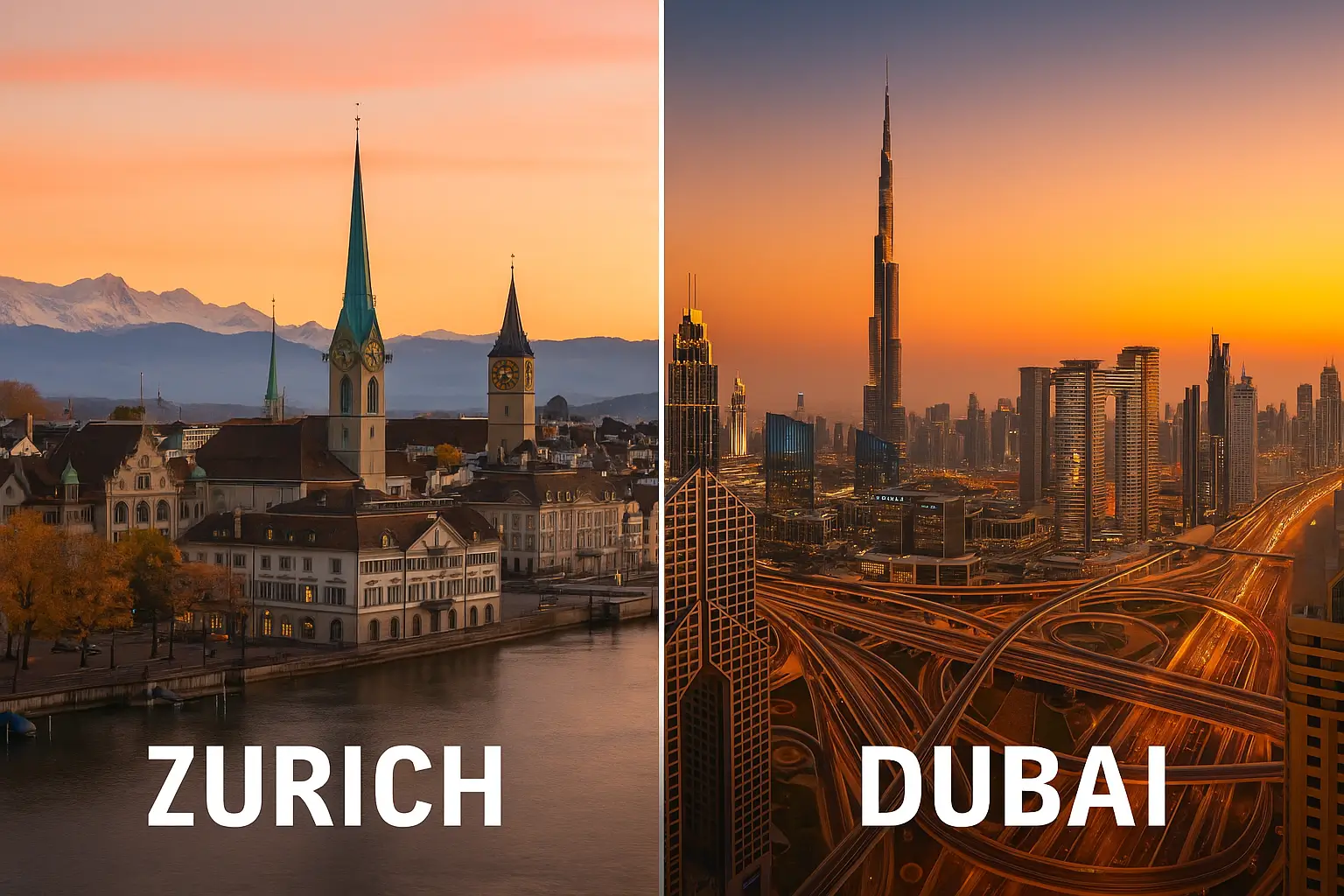
The Global Financial Centres Index (GFCI) is the benchmark that investors, regulators, and governments watch closely. From Zurich to Singapore, London to Dubai, the global financial centres ranking tells a story not just of strength but also of vulnerability. Finance can make a country wealthy—or expose it to collapse.
Switzerland: Stability in Depth
Zurich and Geneva consistently score high in the global financial centres rankings. Finance represents around 10% of Swiss GDP, supported by strong institutions, the rule of law, and a diversified economy. This stability has made Switzerland the world’s archetypal safe haven. But even here, global pressure on tax transparency and digital transformation is forcing evolution.
Singapore: Strategy Over Serendipity
Singapore shows how a nation without natural resources can climb the financial centre rankings through deliberate strategy. With modern regulation, cutting-edge infrastructure, and deep global connectivity, Singapore has become Asia’s premier wealth hub. Finance here is no accident—it is national policy.
Dubai: A High-Stakes Gamble
Dubai’s International Financial Centre has propelled it up the GFCI ranking, fuelling growth in banking, real estate, tourism, and trade. Yet the model is fragile: capital inflows are volatile, the region faces geopolitical uncertainty, and international watchdogs, such as the FATF, add pressure. When one sector falters, the others can tumble with it.
London: A Cautionary Tale
London remains a top entry in the global financial centres index, but its dominance has become a liability. The 2008 crisis revealed structural weaknesses, and Brexit further eroded trust. Over-reliance on finance risks overshadowing the real economy, turning national strength into national vulnerability.
The Lesson for Global Financial Centres
Ranking high is not enough. The most sustainable global financial centres combine regulation, diversification, and institutional depth. Switzerland and Singapore balance it well. London and Dubai show how quickly success can shift. The global financial centres ranking may highlight winners, but resilience decides who stays at the top.
How to Read the Global Financial Centres Index
The Global Financial Centres Index is built on a survey, and that shapes what it can tell you. Scores combine questionnaire responses from finance professionals with a set of external indicators. A centre can therefore rise because perception improved and not because anything changed in reality. Movement at the top is often random. Trust it only when it holds across several editions.
For private wealth the ranking also measures the wrong thing in places. The Global Financial Centres Index rewards breadth: trading volume, fintech, human capital, infrastructure. A client choosing where to book assets cares about depositor protection, legal stability and the quality of one relationship. Zurich and Geneva score well on both counts. The two questions are not the same.
Read next: Switzerland and Singapore compared
Source: https://vapa.ch/global-financial-centres-ranking/ · vapa.ch


