
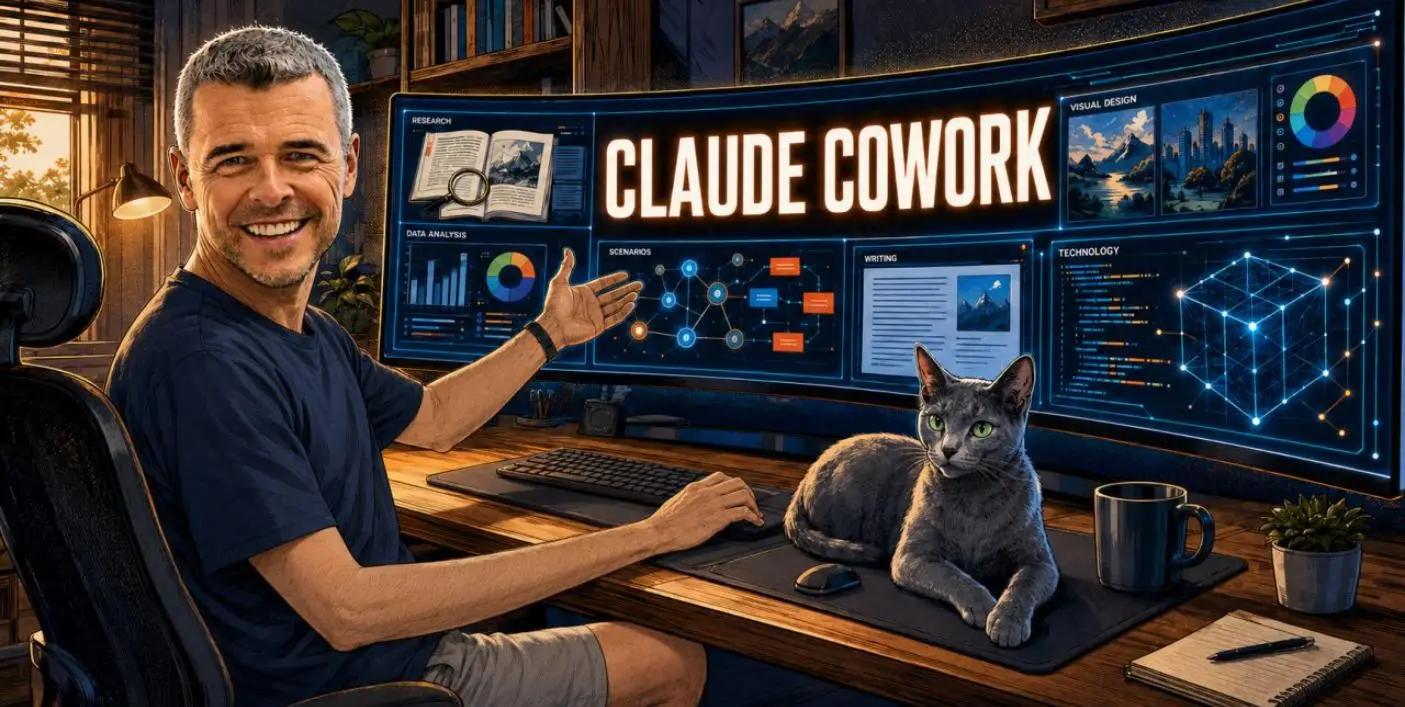
Sitting at the same computer I use at home to pay bills and book holidays, I realised I was no longer simply using software. I was directing a team. Within one connected flow, AI co-work helped me research a subject, analyse data, develop scenarios, challenge assumptions, shape the narrative and create the visuals.
Tasks that once spanned several applications and specialists were coming together on one ordinary screen.
What impressed me most was not any single result. It was the range of available capabilities and the freedom to combine them without being confined to the functions of one standard product. I could start with the outcome and change the mix as the question evolved. Then an unexpected analogy struck me: my home computer felt like an independent wealth manager.
Why the Analogy Holds
Of course, AI is not a Swiss wealth manager. It cannot replace human judgement, accountability or trust. But the operating principle is similar. An independent wealth manager does not begin with a proprietary product shelf. The starting point is the client’s objective, followed by a broader universe of specialists, instruments and perspectives.
AI co-work introduces the same open-architecture logic to knowledge work.
A Larger Shelf, Not a Bigger Tool
Its power is not one tool that does everything. Rather, it is access to a larger shelf of possibilities, coordinated around a specific purpose. As that shelf expands, the human role becomes more important, not less: we provide the context, set the direction, challenge the output and remain responsible for the result.
That may be the most remarkable part of AI co-work. Open architecture is no longer reserved for large institutions. It is arriving on the ordinary computer at home.
If this is possible from home today, what will happen when organisations learn to work this way?
What Changes Inside a Firm
Individual productivity is the easy part. Consequently, the harder question is organisational: who sets the direction, who reviews the output, and who carries the responsibility. Firms that have already thought about organisational balance tend to adopt new capabilities far more calmly than those that have not.
Meanwhile, the economics have shifted. Recent figures on what AI costs by the token show that the barrier is no longer the budget. Instead, the barrier is method: knowing where efficiency genuinely helps a client, and where it merely produces more output.
Judgement Remains the Scarce Resource
Because the shelf keeps growing, attention becomes the limiting factor. How a team spends its hours — the classic question of time allocation — decides whether all this capability reaches the client at all.
Experience still shapes the questions we ask, and experience changes the question long before it changes the answer. Ultimately, the firms that handle disruption well will be those that treat AI co-work as a way of thinking rather than as a piece of software.