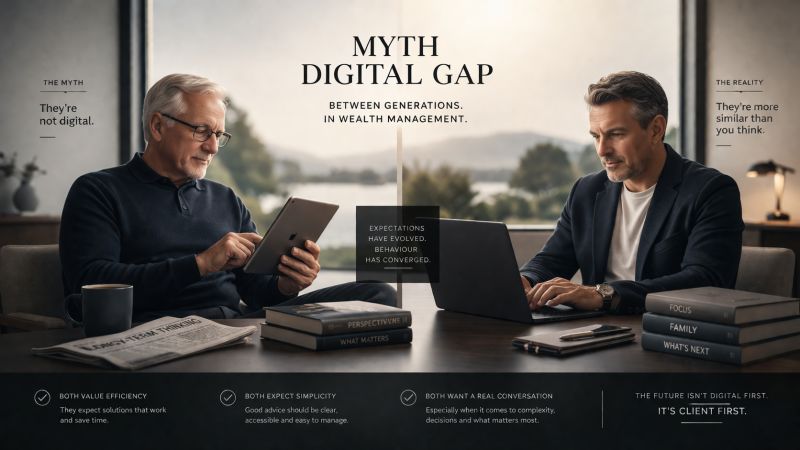
When people discuss the great wealth transfer, one topic dominates the conversation: digitalisation. Many assumptions around digital wealth management myths start from the idea that younger generations demand fully digital solutions.
At first glance, this sounds logical. A new generation enters the market, expectations shift, and everything supposedly becomes faster, more automated and more technology-driven.
However, the reality is far less dramatic.
Digital wealth management myths and generational behaviour
The so-called digital gap between Baby Boomers and Generation X is often overstated. Generation X is comfortable with technology, but not necessarily “digital-first” in an ideological sense. Most clients remain highly practical in their expectations.
At the same time, many Baby Boomers now have more time and genuine curiosity to explore digital tools. Meanwhile, Generation X spent the past decades building careers, raising families and managing wealth. Technology was always present, but rarely the main priority.
As a result, behaviour between both groups is much more similar than many institutions assume.
Both generations value efficiency. Both expect simplicity. And most importantly, both still want access to real conversations when decisions become complex.
As discussed in client relationships in wealth management, trust cannot be replaced by interfaces alone.
Client first wealth management and technology
Technology clearly matters. It improves access, speeds up processes and increases transparency. However, it does not replace judgment, experience or context.
This is where many institutions misunderstand client expectations. Most clients are not asking for fully digital solutions. Instead, they want better decisions delivered more efficiently.
This becomes especially important in the UHNW segment, where complexity increases, and standardised approaches no longer work effectively.
Independent wealth managers are particularly well-positioned in this environment. They combine digital tools with personal advice without forcing clients into rigid systems.
Insights from technology and AI in wealth management also show that technology creates value when it supports relationships rather than replacing them.
Ultimately, the future of wealth management will not be “digital first”.
It will be client first.